
On the Focal Length Selection of Collimators
Date Published: 2026-05-16 16:33:02
Focal length is a crucial technical indicator for a collimator and the primary technical parameter to consider when selecting one. On one hand, according to the object-image relationship expression in geometric optics, theoretically, as long as the focal length of the collimator is accurately measured, the technical parameters of the optical instrument under test can be calculated and derived without considering the magnitude of the focal length. However, in practice, due to the inevitable positional error of the collimator's target plate, according to Newton's formula, for a certain amount of defocus, the parallelism error of the output light is inversely proportional to the focal length. Therefore, it is necessary to balance the focal length of the collimator based on the requirements for the parallelism of the output light and the calibration accuracy of the target plate.
On the other hand, when measuring the geometric parameters (focal length, relative aperture, etc.) and imaging quality of an optical instrument, to reduce measurement errors, the focal length of the collimator is generally selected to be 3 to 5 times that of the instrument being tested.
There are two main benefits of a long focal length:
1. According to Newton's formula, the output light parallelism error caused by the defocus amount can be derived as shown in the following formula. It can be seen that the output light parallelism error caused by the defocus of the collimator is inversely proportional to the square of the focal length:
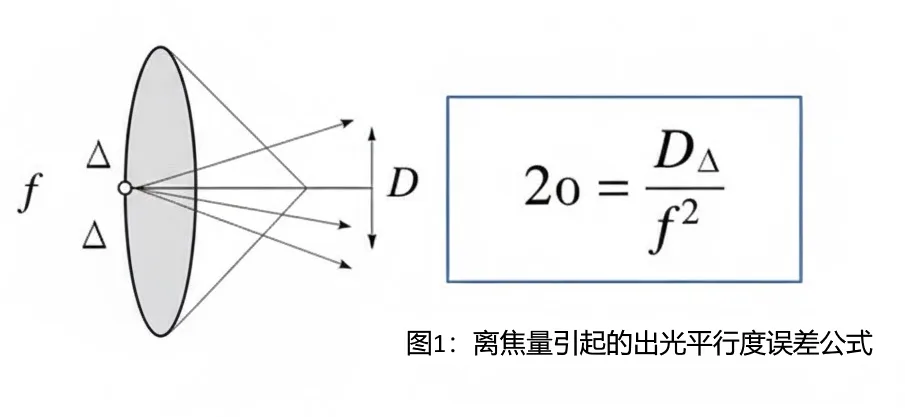
In the formula, 2θ is the angle of the output light, D is the aperture of the collimator, Δ is the defocus amount, and f is the system focal length. For the same defocus error control accuracy of 0.01mm, for a 300mm aperture, the output light parallelism errors caused by focal lengths of 3000mm, 6000mm, and 8000mm are respectively:
2. According to Gauss's formula, the output light parallelism error caused by the positional error of the target plate can be derived as shown in the following formula. It can be seen that the output light parallelism error caused by the positional error of the target plate is inversely proportional to the square of the focal length:
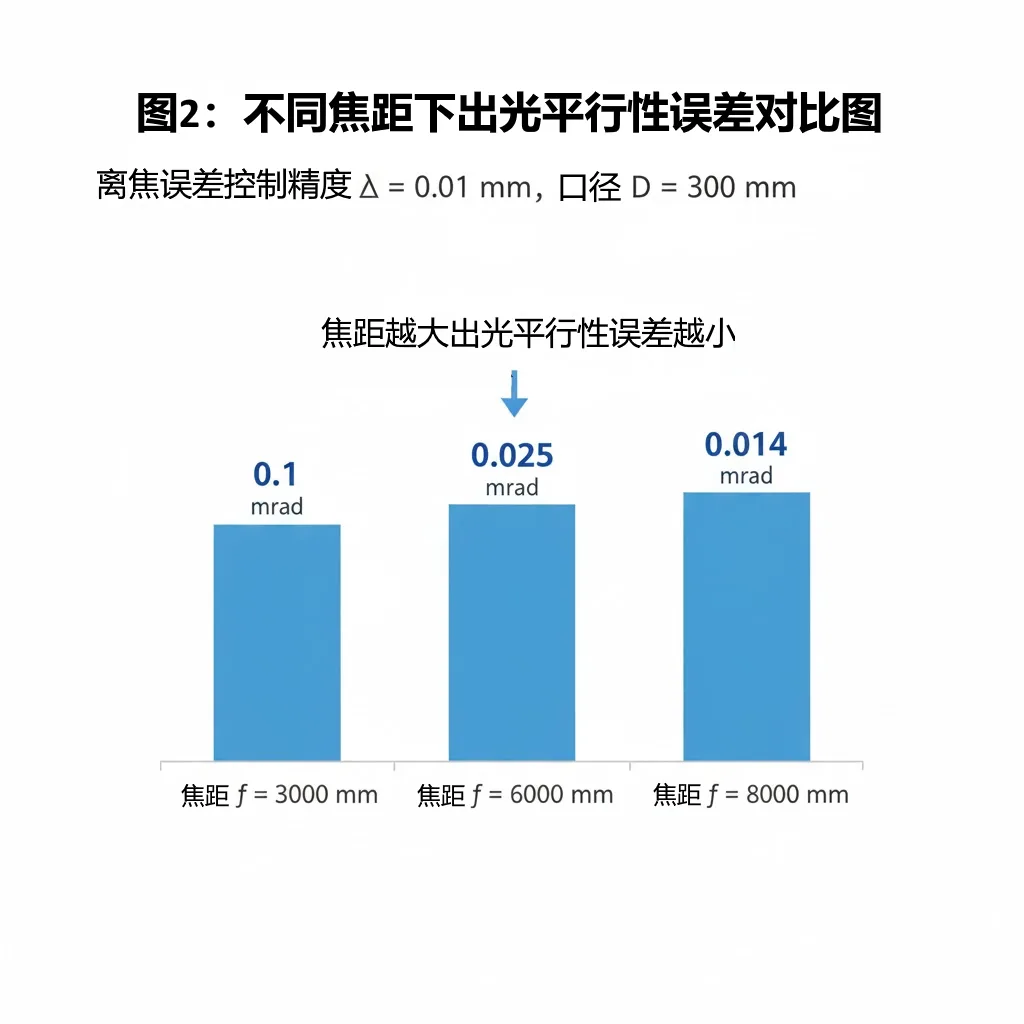
Therefore, to improve the accuracy of the collimator, a long focal length collimator should be selected. Of course, the longer the focal length, the larger the volume of the collimator, which will bring difficulties to structural design, processing, assembly, and use.
In actual use, when selecting the focal length of a collimator, factors such as accuracy requirements, usage environment, and cost should be comprehensively considered to select the most suitable focal length.